

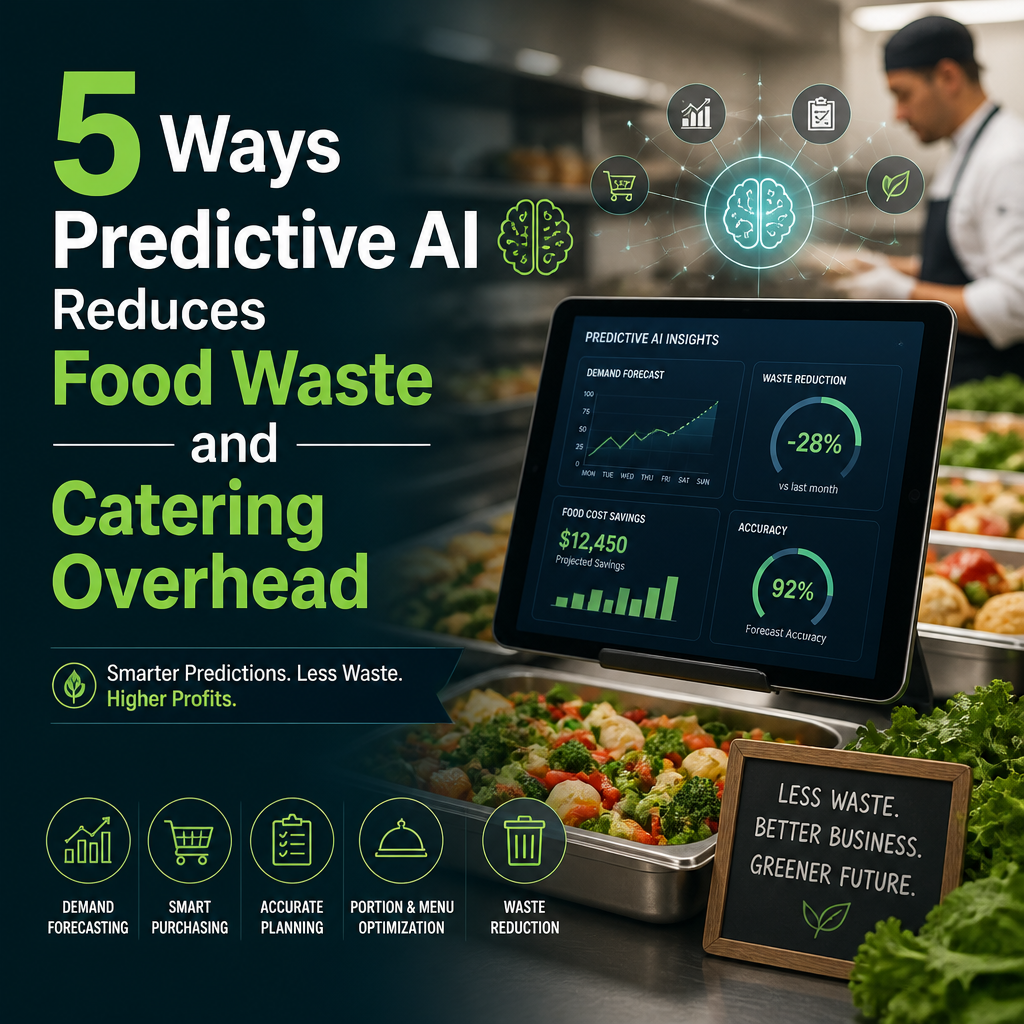
5 Ways Predictive AI Reduces Food Waste and Catering Overhead
5 Ways Predictive AI Reduces Food Waste and Overhead for Large-Scale Caterers
Large-scale catering operations serve thousands of meals across venues, events, hospitals, schools, and corporate facilities. With that scale comes a difficult balancing act: prepare enough food to meet demand without overbuying ingredients, overstaffing kitchens, or sending excess meals to waste.
Predictive AI is helping caterers manage this challenge more accurately. By analyzing historical data, current conditions, and operational patterns, these systems can improve decisions across the entire food-service process. Here are five ways predictive AI reduces food waste and overhead for large-scale caterers.
1. Forecasting Demand More Accurately
One of the biggest causes of food waste is inaccurate demand forecasting. Catering teams may prepare extra portions to avoid shortages, but those safety margins can result in significant leftovers when attendance is lower than expected.
Predictive AI uses data such as:
- Historical event attendance
- Seasonal demand patterns
- Menu popularity
- Guest demographics
- Booking trends
- Weather forecasts
- Local events and holidays
By combining these factors, AI can estimate how many meals are likely to be needed for a specific event or service period. This allows caterers to move beyond simple averages and make forecasts based on the actual circumstances surrounding each order.
More accurate forecasts reduce unnecessary preparation while preserving service quality and customer satisfaction.
2. Optimizing Ingredient Purchasing
Over-ordering ingredients ties up cash and increases the risk of spoilage. Under-ordering, however, can lead to rushed purchases, higher prices, and menu substitutions. Predictive AI helps caterers find a more efficient middle ground.
AI-powered purchasing tools can evaluate upcoming menus, expected guest counts, supplier lead times, inventory levels, and ingredient shelf life. They can then recommend what to buy, when to buy it, and in what quantities.
For example, if demand for a particular salad is expected to decline next week, the system may suggest reducing purchases of leafy greens and other perishable ingredients. At the same time, it can identify products that should be ordered earlier because of rising demand or limited supplier availability.
This reduces spoilage and helps catering businesses avoid costly last-minute procurement.
3. Improving Inventory Management
Large-scale kitchens often manage hundreds or thousands of ingredients across multiple storage areas. Without precise tracking, products can be forgotten, misplaced, or used after their optimal freshness window.
Predictive AI can monitor inventory movement and identify patterns that are difficult to spot manually. It can flag items that are approaching expiration, predict which products are likely to remain unused, and recommend substitutions based on current stock.
AI can also support the “first in, first out” method by helping staff prioritize older inventory. Automated alerts may notify kitchen managers when ingredients should be moved into production or incorporated into upcoming menus.
Better inventory visibility reduces waste while limiting emergency purchases and unnecessary stock accumulation.
4. Matching Labor to Demand
Labor is one of the largest operating expenses for large-scale caterers. Overstaffing raises costs, while understaffing can cause delays, overtime, and production mistakes.
Predictive AI analyzes expected meal volumes, preparation times, service schedules, staffing availability, and employee productivity. Based on this information, it can help managers create more efficient schedules.
For instance, an operation may require more prep staff in the morning but additional service workers during a peak delivery or event window. Predictive scheduling helps place employees where and when they are most needed.
This reduces overtime and improves productivity without sacrificing food quality or service speed. It can also help managers anticipate busy periods and arrange staffing before shortages occur.
5. Reducing Overproduction and Post-Service Waste
Even when purchasing and preparation are carefully planned, catering teams may still produce more food than guests consume. Predictive AI can help identify where overproduction occurs and why.
By analyzing post-event data, including leftovers, return rates, portion sizes, and menu performance, AI can reveal trends such as:
- Certain dishes consistently being overproduced
- Specific portions being too large
- Menu items receiving low customer interest
- Events with predictable attendance fluctuations
- Service periods associated with higher waste
Caterers can use these insights to adjust recipes, serving sizes, production quantities, and menu selections. Over time, each event generates new data that improves future predictions.
Some systems can also help determine whether safe surplus food should be redirected to another service period, donated, or repurposed according to food-safety guidelines.
Building a More Efficient Catering Operation
Predictive AI does more than reduce food waste. It helps large-scale caterers control purchasing costs, improve labor efficiency, protect profit margins, and make better use of their kitchens and facilities.
The most effective results come when AI recommendations are combined with staff experience. Kitchen managers and event planners understand practical details that may not appear in historical data, while predictive tools can process large amounts of information quickly and consistently.
By adopting predictive AI across forecasting, purchasing, inventory, staffing, and production, caterers can create a more responsive operation—one that delivers excellent service while wasting less food and money.