
The ROI of Automated Catering Operations: How Technology Saves Hours on Every Banquet Event Order (BEO)
Meta Description: Discover how automated catering operations reduce the time spent managing banquet event orders (BEOs), minimize manual errors, improve team productivity, and increase profitability for modern catering businesses.
Introduction
In catering and hospitality, every successful event depends on accurate planning, clear communication, and precise execution. From corporate luncheons to large-scale banquets, teams must coordinate menus, guest counts, dietary requirements, staffing, equipment, and service schedules. Much of this information comes together in the Banquet Event Order (BEO), a critical document that guides everyone involved in delivering an event.
However, preparing and updating BEOs manually can consume valuable staff hours. Repeated data entry, last-minute changes, and communication gaps can create unnecessary administrative work and increase the risk of costly mistakes. Automated catering operations offer a practical way to streamline these processes while delivering measurable returns on investment (ROI).
The Hidden Cost of Manual BEO Management
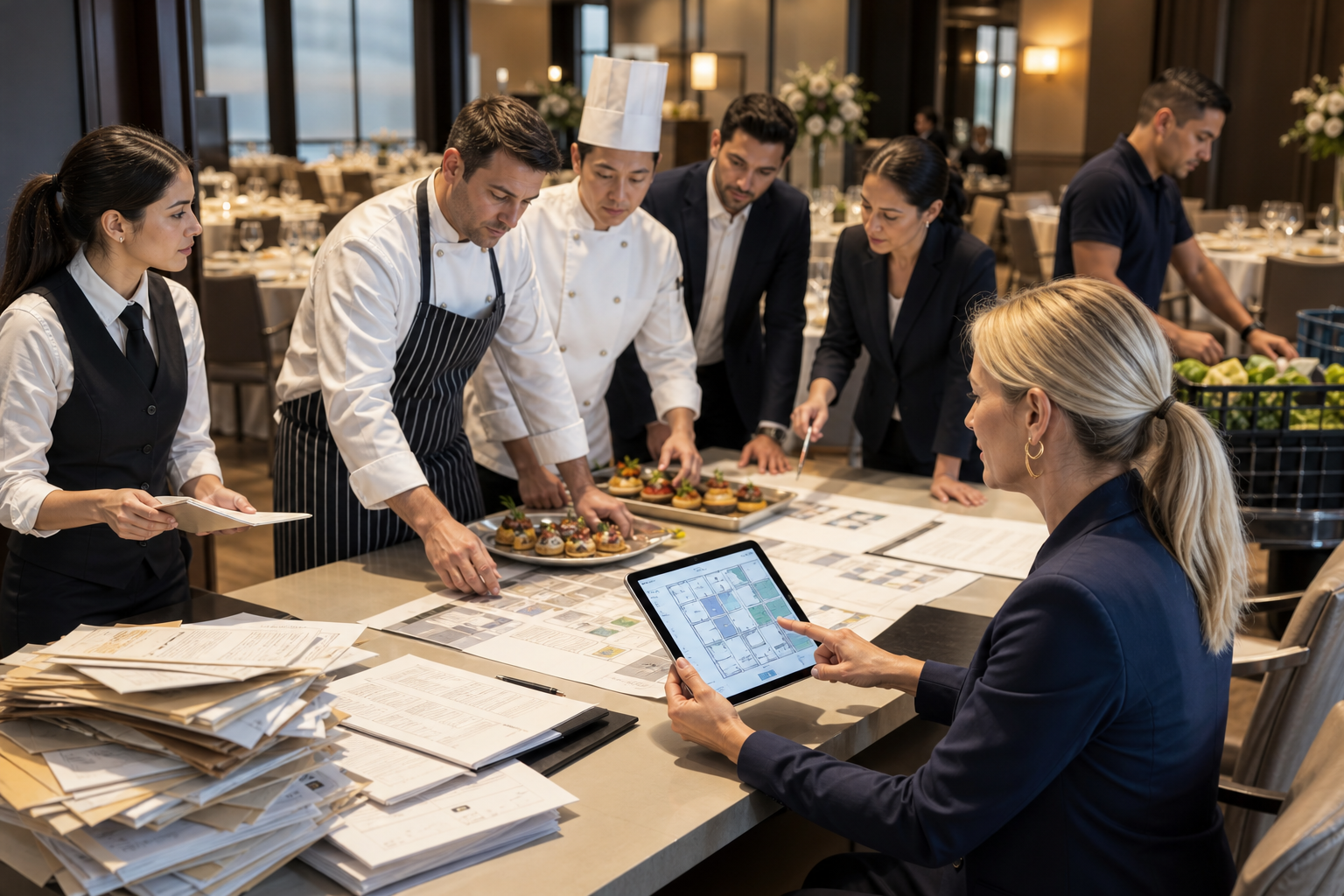
Creating a BEO often requires gathering information from emails, spreadsheets, customer conversations, and booking systems. Staff must organize these details, confirm accuracy, distribute updates, and ensure that every department works from the latest version.
When event details change, the process often starts again. A revised guest count may affect food quantities, staffing, table arrangements, and purchasing decisions. If updates do not reach every team member, mistakes can occur during preparation or service.
Although these tasks may seem routine, the time spent repeating them across dozens of events can become a significant operational expense. Manual administration also limits the time staff can dedicate to customer relationships, sales, and business development.
How Automation Streamlines Catering Operations
Automated catering systems centralize event information and reduce the need to recreate documents manually. Depending on the platform, event details entered during booking can populate BEOs, generate task lists, and support communication between sales, kitchen, logistics, and service teams.
Key benefits include:
- Faster BEO creation: Reusable templates and connected data reduce repetitive entry.
- Consistent information: Centralized records help teams access current event requirements.
- Simplified updates: Changes to guest counts, menus, or schedules can be managed more efficiently.
- Improved coordination: Relevant teams can access the information they need to prepare for service.
- Fewer avoidable errors: Validation rules and standardized workflows help identify missing or inconsistent details.
By reducing administrative friction, automation allows catering professionals to focus more on delivering exceptional experiences.
Calculating the ROI of Catering Automation
The financial value of automation extends beyond time savings. It can also help reduce rework, improve resource allocation, and create capacity for additional bookings.
Consider a catering team that processes 40 BEOs each month. If automation saves 45 minutes per order, the business recovers 30 staff hours monthly.
At an illustrative labor cost of $25 per hour, that represents $750 in potential monthly labor capacity, or $9,000 annually.
These figures are examples rather than guaranteed savings. Actual returns depend on order volume, current workflows, labor costs, software expenses, and how effectively the recovered time is used.
A simple ROI calculation is:
ROI = (Financial Benefits − Automation Costs) ÷ Automation Costs × 100
To measure performance accurately, catering businesses should track average BEO preparation time, revision frequency, error rates, administrative labor costs, and the total cost of implementing and maintaining automation.
Beyond Time Savings: Improving the Customer Experience
Operational efficiency also influences customer satisfaction. Faster confirmations, more accurate event details, and clearer communication help create a smoother planning experience.
When staff spend less time correcting documents and chasing information, they can respond to customer questions more promptly and devote greater attention to customization.
Automation can also support scalability. As booking volumes increase, standardized workflows help businesses manage additional events without increasing administrative workload at the same rate.
Conclusion
Automating catering operations is not simply about producing BEOs faster. It is about creating a more connected workflow that improves accuracy, strengthens team coordination, and makes better use of staff time.
By measuring time saved, reducing avoidable errors, and comparing these benefits with implementation costs, catering businesses can evaluate the true ROI of automation. The result can be a more efficient operation, a better customer experience, and greater capacity to grow profitably in a competitive hospitality market.