

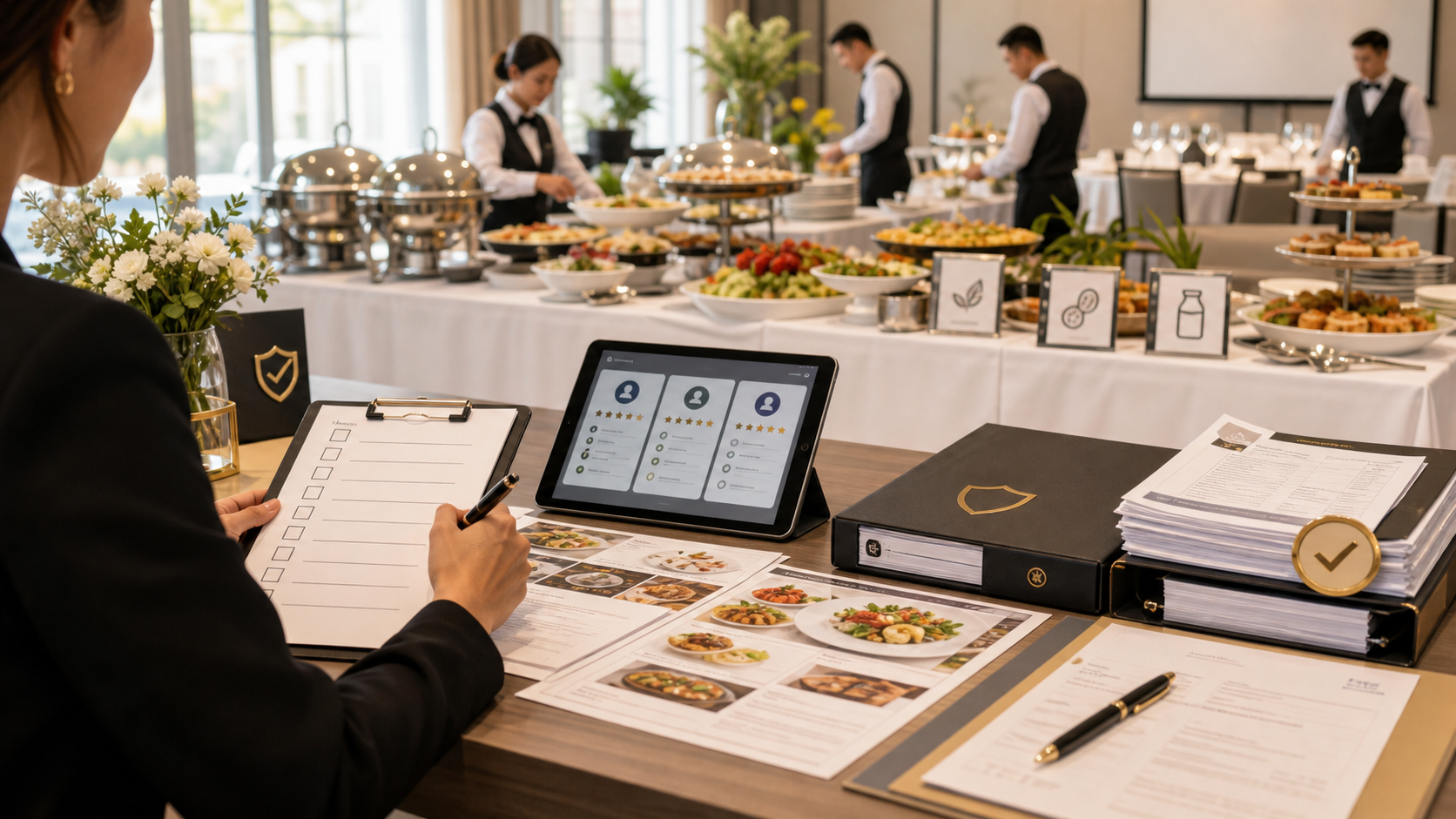
The Event Host’s Essential Checklist for Finding Verified, Top-Rated Commercial Caterers
Meta Description: Discover how event hosts can find verified, highly rated commercial caterers using customer reviews, credentials, menu evaluations, transparent pricing, and AI-powered catering discovery tools.
Introduction
Choosing the right commercial caterer can make or break an event. Whether organizing a corporate conference, business luncheon, wedding, or large-scale celebration, event hosts need a catering partner who delivers quality food, reliable service, and professional execution.
However, comparing providers can be time-consuming. Online ratings may not tell the whole story, and attractive menus do not always guarantee dependable service. A structured checklist helps event organizers evaluate catering companies confidently, reduce uncertainty, and choose a provider that meets their event requirements.
1. Verify the Caterer’s Business Credentials
Before discussing menus or pricing, confirm that the catering company is a legitimate, established business.
Check its business registration where applicable, relevant food-service permits, insurance coverage, and compliance with local health and safety requirements. Requirements vary by location, so confirm which documents apply to your event.
For larger corporate events, ask whether the caterer has experience serving venues with specific security, access, or operational requirements. Request references from previous clients when appropriate.
Checklist:
- Confirm business identity and contact information.
- Verify applicable licenses and food-service permits.
- Ask about liability insurance and food safety procedures.
- Request relevant corporate references or previous event examples.
2. Evaluate Ratings and Customer Reviews
Online ratings can provide valuable insights into a caterer’s consistency and customer experience. However, a high average score alone should not determine your decision.
Read recent reviews across multiple platforms, paying attention to recurring comments about food quality, punctuality, communication, presentation, and staff professionalism. Look for detailed feedback from customers who hosted events similar to yours.
Be cautious of vague or repetitive reviews, and investigate patterns of unresolved complaints. When possible, request references from clients with comparable guest counts and service expectations.
Checklist:
- Review recent feedback across multiple sources.
- Evaluate the number and relevance of reviews.
- Look for consistent service quality and reliability.
- Ask how the caterer addresses complaints or unexpected problems.
3. Match the Menu to Your Event Requirements
A suitable caterer should offer more than appealing dishes. Its menu must accommodate your guests, venue, event format, and budget.
Discuss dietary restrictions, vegetarian and vegan options, allergies, cultural preferences, and food labeling. Ask whether menus can be customized and how the team maintains food quality during transportation and service.
For large gatherings, confirm the caterer’s capacity to prepare, transport, and serve the required quantity without compromising quality.
Checklist:
- Review menu options and request a tasting when practical.
- Confirm dietary accommodations and allergen procedures.
- Evaluate presentation and portion sizes.
- Verify guest capacity, delivery arrangements, and serving requirements.
4. Compare Quotes, Contracts, and Service Details
An affordable initial quote may not reflect the final cost. Request itemized proposals from suitable providers and compare what each package includes.
Check food costs, delivery fees, staffing, equipment rentals, setup, cleanup, taxes, service charges, and potential overtime expenses. Review payment schedules, cancellation policies, deadlines, and procedures for changes in guest numbers.
A written agreement should clearly outline responsibilities, delivery times, service expectations, and contingency arrangements.
Checklist:
- Obtain itemized quotes from multiple caterers.
- Compare equivalent services rather than headline prices.
- Review contracts, cancellation terms, and payment conditions.
- Confirm responsibilities and backup plans in writing.
5. Use AI to Simplify Caterer Discovery
Finding and comparing suitable providers can become easier with AI-powered catering discovery and lead management tools. Depending on their capabilities, these platforms can help organize catering options, filter providers by location and event requirements, summarize available business information, and streamline initial inquiries.
For event hosts, the benefit is a more organized evaluation process. Instead of managing scattered emails and notes, organizers can maintain a clearer view of potential vendors, compare proposals, and track conversations.
However, AI-generated recommendations should be treated as a starting point—not proof of quality. Always verify credentials, current ratings, availability, pricing, and references directly with the provider.
Conclusion
Selecting a verified, highly rated commercial caterer requires careful evaluation of credentials, customer feedback, menus, pricing, and operational reliability. A structured checklist helps event hosts compare providers consistently and avoid costly surprises.
By combining thorough research with organized digital tools and direct communication, event planners can make informed decisions and create a smoother catering experience. The best choice is not necessarily the caterer with the highest rating or lowest quote, but the provider whose verified capabilities, service standards, and value align with the event’s specific needs.